 SinoXiv
JWST Reveals a Strange Sulfur World Unlike Any Planet We Know
Abstract
Body
A research team led by the University of Oxford has uncovered evidence for a previously unknown kind of planet beyond our Solar System -- one that locks away large quantities of sulfur deep inside a long lasting ocean of molten rock. The results were published on March 16 in >Nature Astronomy>.
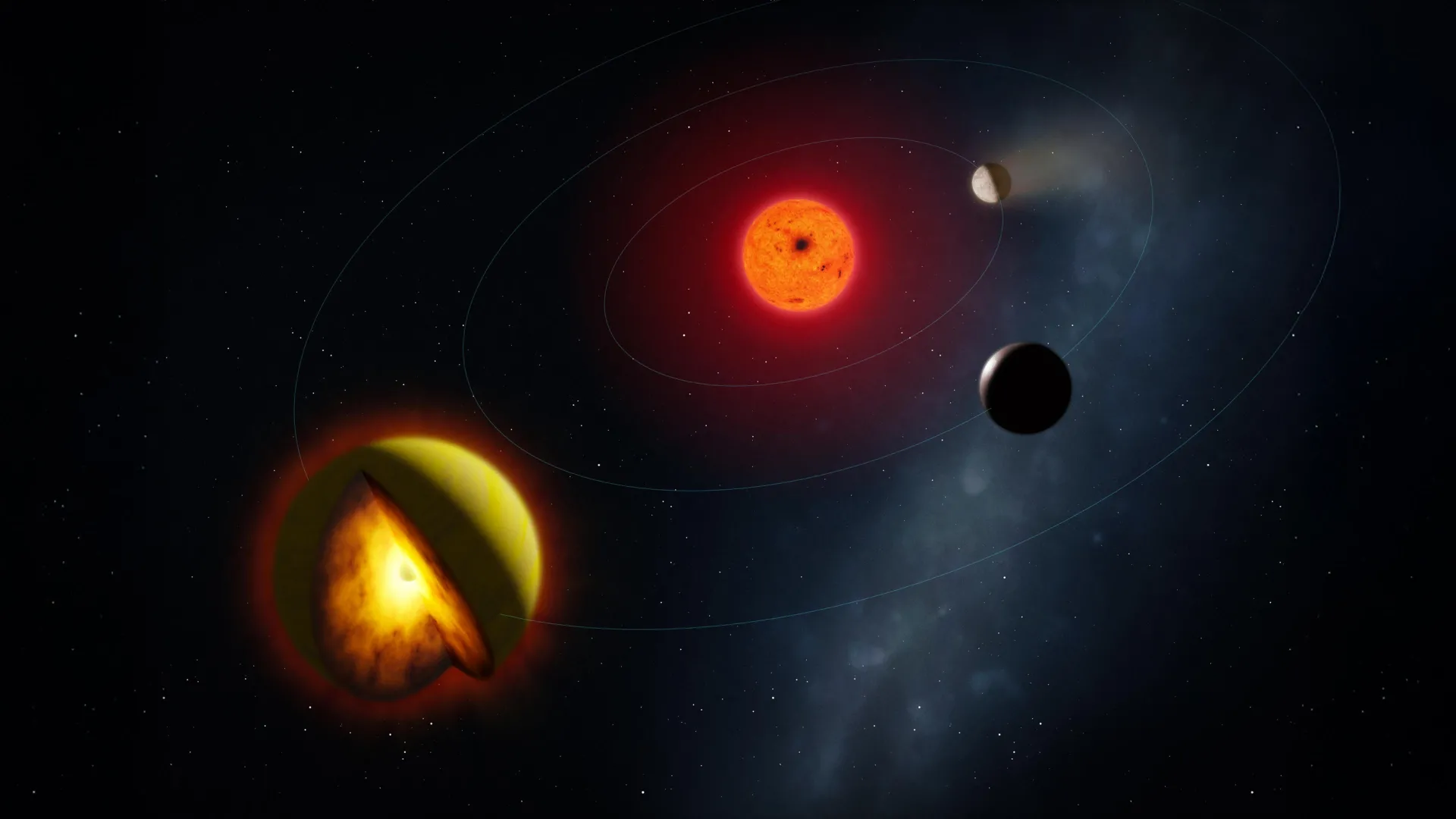
The world, called L 98-59 d (an exoplanet, meaning it orbits a star outside our Solar System), circles a small red star about 35 light-years from Earth. Data from the James Webb Space Telescope (JWST) and ground based observatories revealed something unusual. For a planet about 1.6 times the size of Earth, it has a surprisingly low density and an atmosphere rich in hydrogen sulfide.
>A Planet That Defies Classification>
Until now, scientists would have grouped a planet like L 98-59 d into one of two categories. It could be a rocky "gas-dwarf" with a hydrogen dominated atmosphere, or a water rich world covered by deep oceans and ice.
New evidence shows it fits neither category. Instead, L 98-59 d appears to belong to a completely different class of planet dominated by heavy sulfur compounds.
>A Global Magma Ocean Beneath the Surface>
To understand this unusual world, researchers from the University of Oxford, the University of Groningen, the University of Leeds and ETH Zurich used advanced computer simulations to trace its evolution from shortly after formation to today, spanning nearly five billion years. By combining telescope observations with detailed models of planetary interiors and atmospheres, they were able to infer what is happening deep inside the planet.

