 SinoXiv
Even JWST Can’t See Through This Planet’s Massive Haze
Abstract
Body
A newly studied exoplanet, Kepler-51d, is wrapped in an unusually dense layer of haze that may be hiding both what it is made of and how it formed. Using NASA's James Webb Space Telescope (JWST), a team led by Penn State researchers took a closer look at this so-called "super-puff" planet, which already challenges standard ideas of how planets develop. What they found made things even more puzzling. The haze surrounding the planet appears to be the thickest ever detected on a world, making it extremely difficult to identify the chemical makeup of its atmosphere or trace its origins.
The findings were published March 16 in the >Astronomical Journal>.
>A Cotton Candy-Like Planetary System>
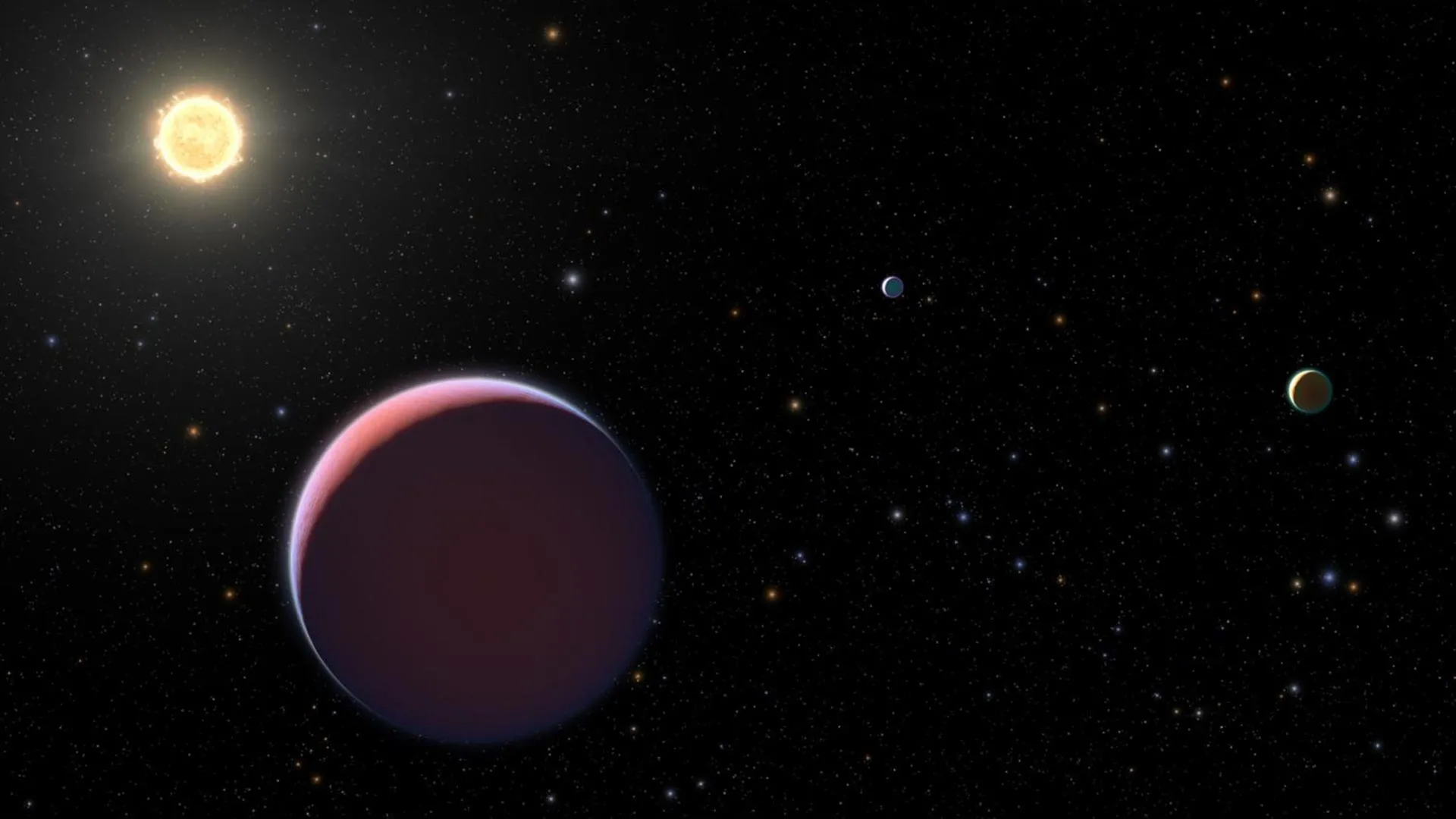
Kepler-51 is a star located about 2,615 light years away in the constellation Cygnus. It hosts four known planets, at least three of which belong to a rare class of ultra-low-density worlds known as super-puffs. These planets are similar in size to Saturn but have only a few times the mass of Earth. Among them, Kepler-51d stands out as both the coolest and the least dense.
"We think the three inner planets orbiting Kepler-51 have tiny cores and huge atmospheres giving them a density akin to cotton candy," said Jessical Libby-Roberts, Center for Exoplanets and Habitable Worlds Postdoctoral Fellow at Penn State at the time of the research and first author of the paper. "These ultra-low-density super-puff planets are rare, and they defy conventional understanding of how gas giants form. And if explaining how one formed wasn't difficult enough, this system has three!"
>Why Kepler-51d Defies Planet Formation Models>
Typically, gas giants form with dense cores that generate strong gravity, allowing them to pull in and hold onto thick atmospheres of gas. These planets usually develop far from their stars, where conditions favor gas accumulation, much like Jupiter and Saturn in our own solar system.

