 SinoXiv
A Black Hole and Neutron Star Just Collided in a Strange Oval Orbit
Abstract
Body
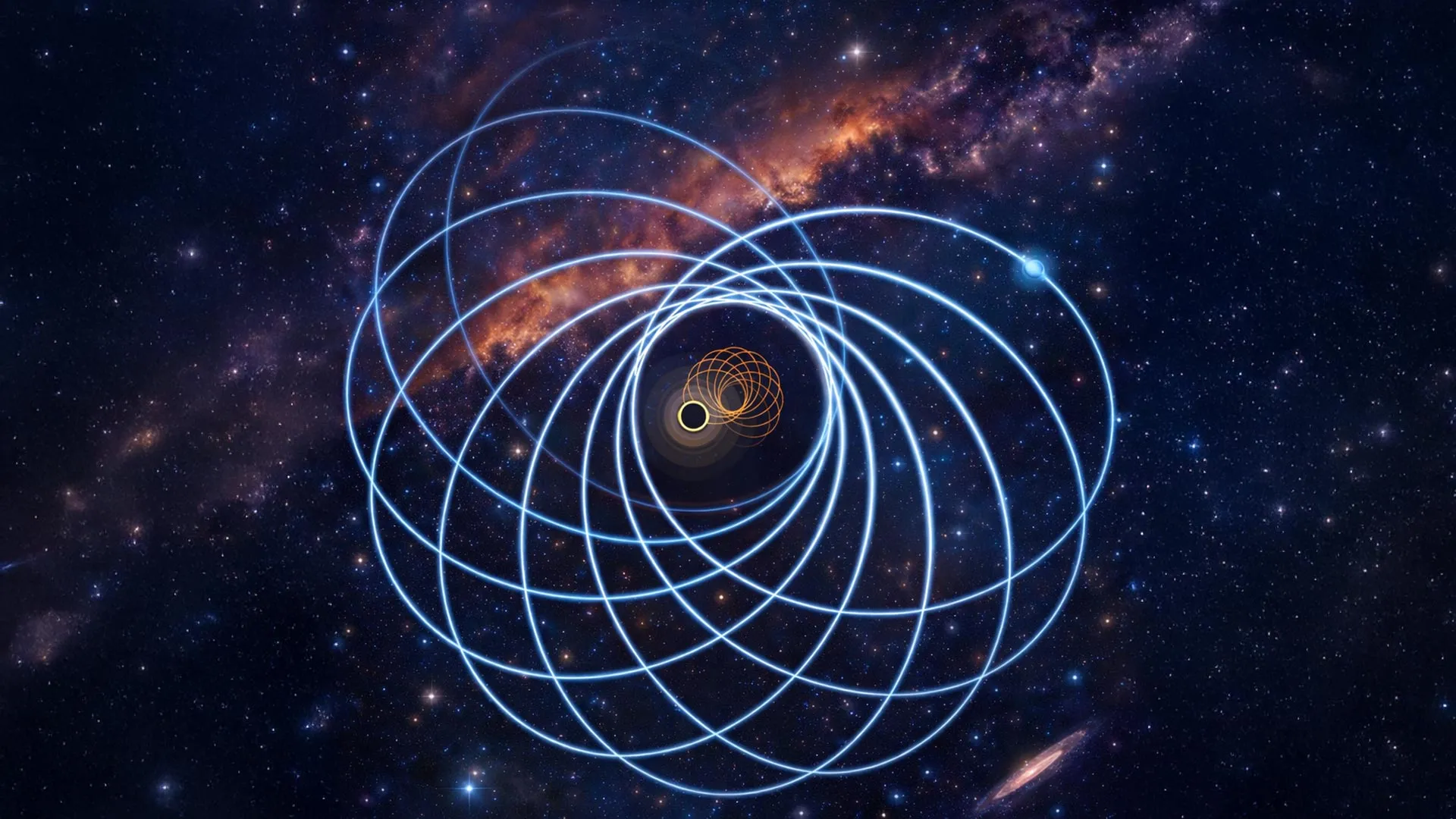
Scientists have found the strongest evidence yet that a black hole and a neutron star collided while moving along an oval shaped orbit instead of the near perfect circles scientists usually expect before such mergers. The discovery challenges long standing ideas about how these extreme cosmic pairs form and evolve.
The research was carried out by scientists from the University of Birmingham, Universidad Autónoma de Madrid, and the Max Planck Institute for Gravitational Physics. Their findings were published on March 11 in >The Astrophysical Journal Letters>.
>Unusual Oval Orbit Detected in Black Hole-Neutron Star Merger>
Astronomers generally expect neutron star and black hole pairs to settle into circular orbits long before they merge. However, a fresh analysis of the gravitational wave event GW200105 revealed that this system was still traveling on an oval shaped path shortly before the two objects combined. The merger ultimately produced a black hole about 13 times the mass of the Sun. Detecting such an oval orbit in this type of event has not been reported before.
Dr. Patricia Schmidt from the University of Birmingham explained: "This discovery gives us vital new clues about how these extreme objects come together. It tells us that our theoretical models are incomplete and raises fresh questions about where in the Universe such systems are born."
>Gravitational Wave Data Reveals Orbital Shape>
To investigate the event, the team studied data from the LIGO and Virgo gravitational wave detectors using a new model developed at the University of Birmingham's Institute of Gravitational Wave Astronomy. This approach allowed researchers to measure how stretched the orbit was (eccentricity) and determine whether the system showed spin related wobbling (precession). It is the first time scientists have measured both of these effects together in a neutron star-black hole event.

