 SinoXiv
A Strange Quantum Metal Just Rewrote the Rules of Electricity
Abstract
Body
Quantum metals are a unique group of materials where quantum behaviors, typically confined to the atomic scale, become strong enough to shape how electricity behaves across the entire material.
A team of researchers in Japan has now uncovered how electric currents move through a particular category of these materials, known as kagome metals. Their study revealed for the first time that even weak magnetic fields can reverse tiny circulating electrical currents inside the metal. This reversal changes how easily current flows depending on direction, producing what scientists call the diode effect -- where electricity passes more freely one way than the other.
The researchers also found that quantum geometric properties amplify this effect by roughly 100 times. Their findings, published in Proceedings of the National Academy of Sciences, establish the theoretical foundation for future electronic technologies that could be tuned or switched using simple magnetic fields.
Since around 2020, scientists have observed this type of magnetic switching in experiments but could not explain the mechanism or why the effect was so pronounced. The new research offers the first complete theoretical explanation for both.
When electrons become "frustrated"
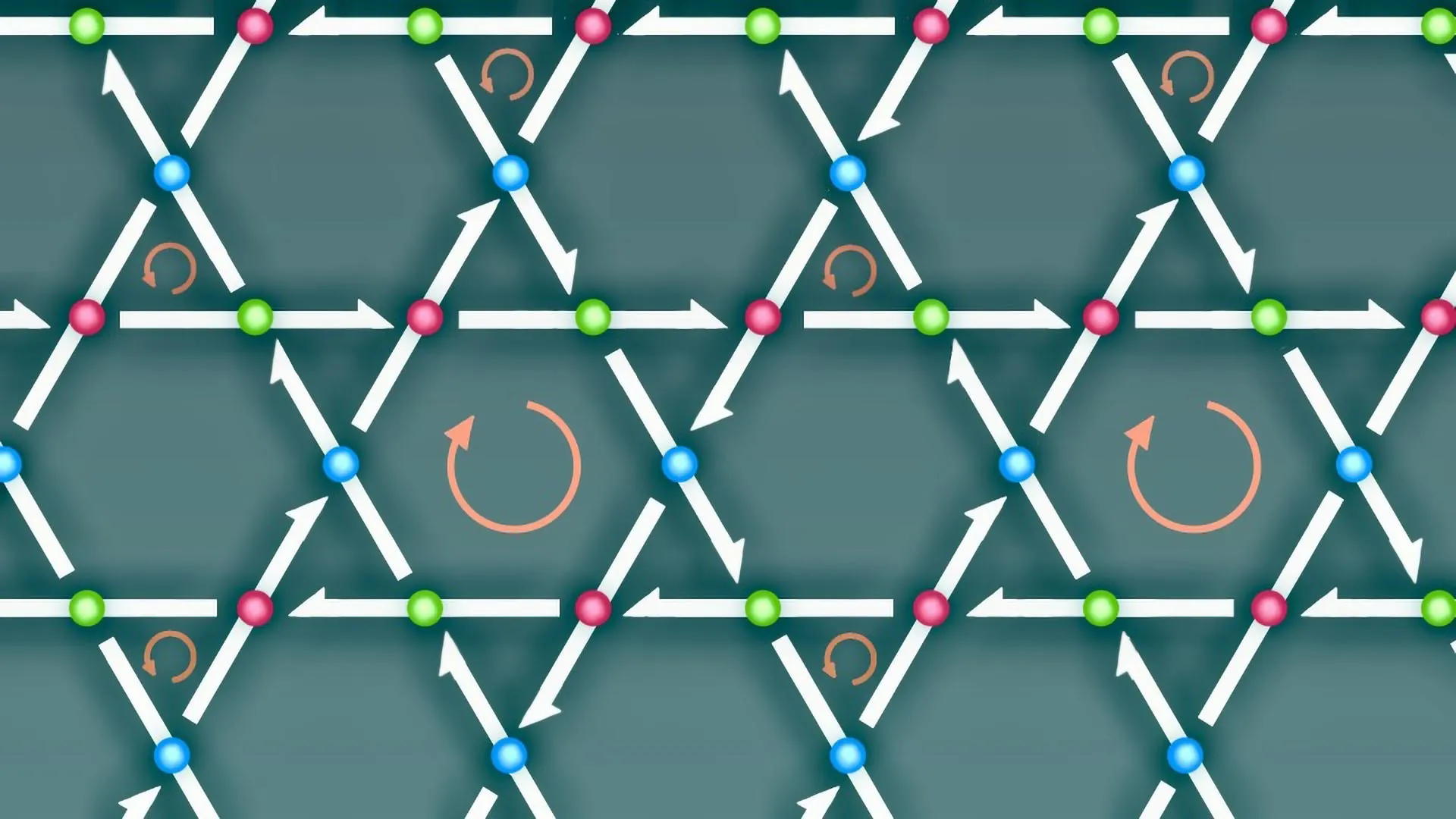
The term "kagome metal" comes from the Japanese word "kagome," meaning "basket eyes" or "basket pattern," inspired by a traditional bamboo weaving technique that creates interlocking triangles.
In these materials, atoms adopt the same distinctive triangular arrangement. This geometry causes what physicists describe as "geometric frustration," a condition where electrons cannot settle into neat, orderly arrangements. Instead, they form intricate quantum states that include the circulating electrical loops observed in experiments.

