 SinoXiv
289-million-year-old Mummified Reptile Reveals How Breathing Began on Land
Abstract
Body
Every breath you take is part of a very ancient story. The steady movement of your chest, the muscles between your ribs pulling outward, and the air filling your lungs feel completely routine. Yet this familiar process traces back hundreds of millions of years. A remarkably preserved reptile that died in an Oklahoma cave about 289 million years ago has now revealed the earliest known example of this breathing system in amniotes -- a group that includes reptiles, birds, mammals, and their shared ancestors, among the first animals to fully adapt to life on land.
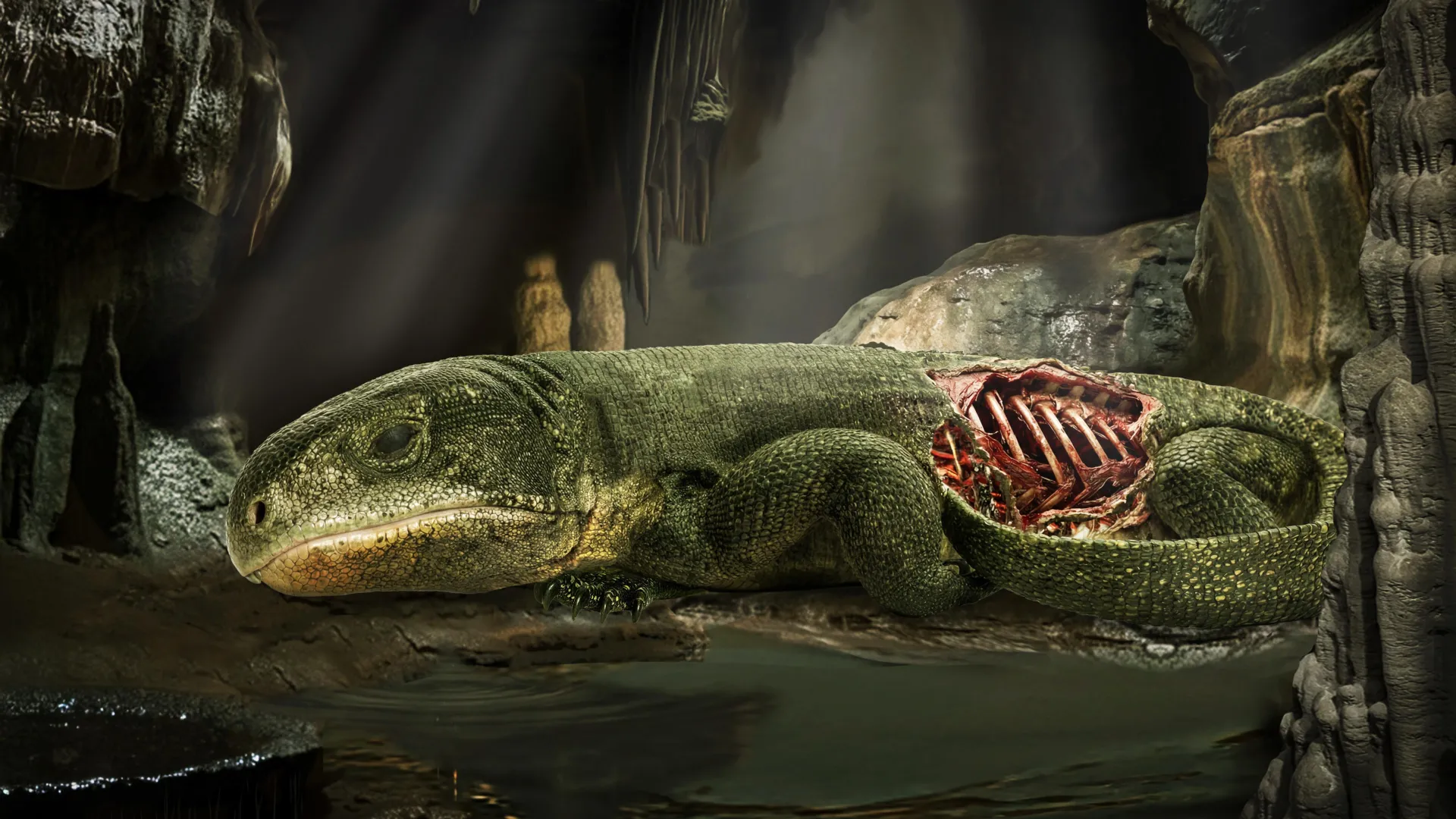
In a study published in Nature, scientists describe the exceptional preservation of a small, lizard-like reptile called Captorhinus aguti from the early Permian period. Although only a few inches long, this fossil contains far more than bones. It preserves three dimensional skin, calcified cartilage, and even traces of proteins. These protein remnants are nearly 100 million years older than any previously identified in fossils.
"Captorhinus is an interesting lizard-looking critter that is critical to understanding early amniote evolution," said Ethan Mooney, who co-led the study while a student at the University of Toronto in co-author Professor Robert R. Reisz's lab and is now a PhD candidate in the Department of Organismic and Evolutionary Biology at Harvard University where he works with paleontologist Professor Stephanie Pierce. These early reptiles varied in size from just a few centimeters to several feet and were among the first to explore life on land. They were both widespread and successful during their time.
Rare Preservation at Richards Spur
The fossil was discovered in cave systems near Richards Spur, Oklahoma, a site known for its extraordinary record of late Paleozoic life. This location contains the most diverse collection of terrestrial vertebrates from that period, which was already rich in species. Unique environmental conditions helped preserve the remains. Oil seep hydrocarbons and oxygen-free mud protected not only bones but also delicate tissues such as skin and cartilage.
As a result, the specimen appears as a three dimensional mummified fossil, frozen in its final position with one arm tucked beneath its body. This level of preservation is extremely rare and offers an unusually detailed view of ancient anatomy.
High-Tech Scans Reveal Skin and Structure
Researchers used neutron computed tomography (nCT) at a specialized facility in Australia to examine the fossil without damaging it. The scans allowed them to see beneath the rock and uncover fine details hidden inside.

