 SinoXiv
This Walking Robot Could Change How We Search for Life on Mars
Abstract
Body
Planetary missions on the surface of Mars are carried out with extreme caution. Communication delays between Earth and robotic explorers can range from four to 22 minutes, and limited data transmission capacity adds another layer of constraint. Because of this, scientists must carefully plan each step in advance. Rovers are also built to conserve energy and avoid hazards, so they move slowly across rough terrain. Most travel only a few hundred meters per day, which limits how much of the landscape they can study and makes it harder to gather a wide range of geological data.
Researchers explored a new strategy designed to overcome these limitations. Instead of relying on constant human direction, they tested a semi-autonomous robot capable of moving from one target to another and collecting data on its own. Equipped with compact instruments, the robot could examine multiple rocks in sequence and perform measurements independently.
The results showed a major improvement in efficiency. Rather than focusing on a single rock under continuous supervision, the robot could navigate to several locations and analyze each one. This approach significantly accelerated both resource prospecting and the search for 'biosignatures' (ie, evidence of life) on planetary surfaces.
The team wanted to know whether a robot carrying a relatively simple set of instruments could still produce meaningful scientific results while working quickly. The findings confirmed that even compact tools were sufficient to meet key objectives, including identifying rocks important for astrobiology and resource exploration.
>Testing a Legged Robot in Mars-Like Conditions>
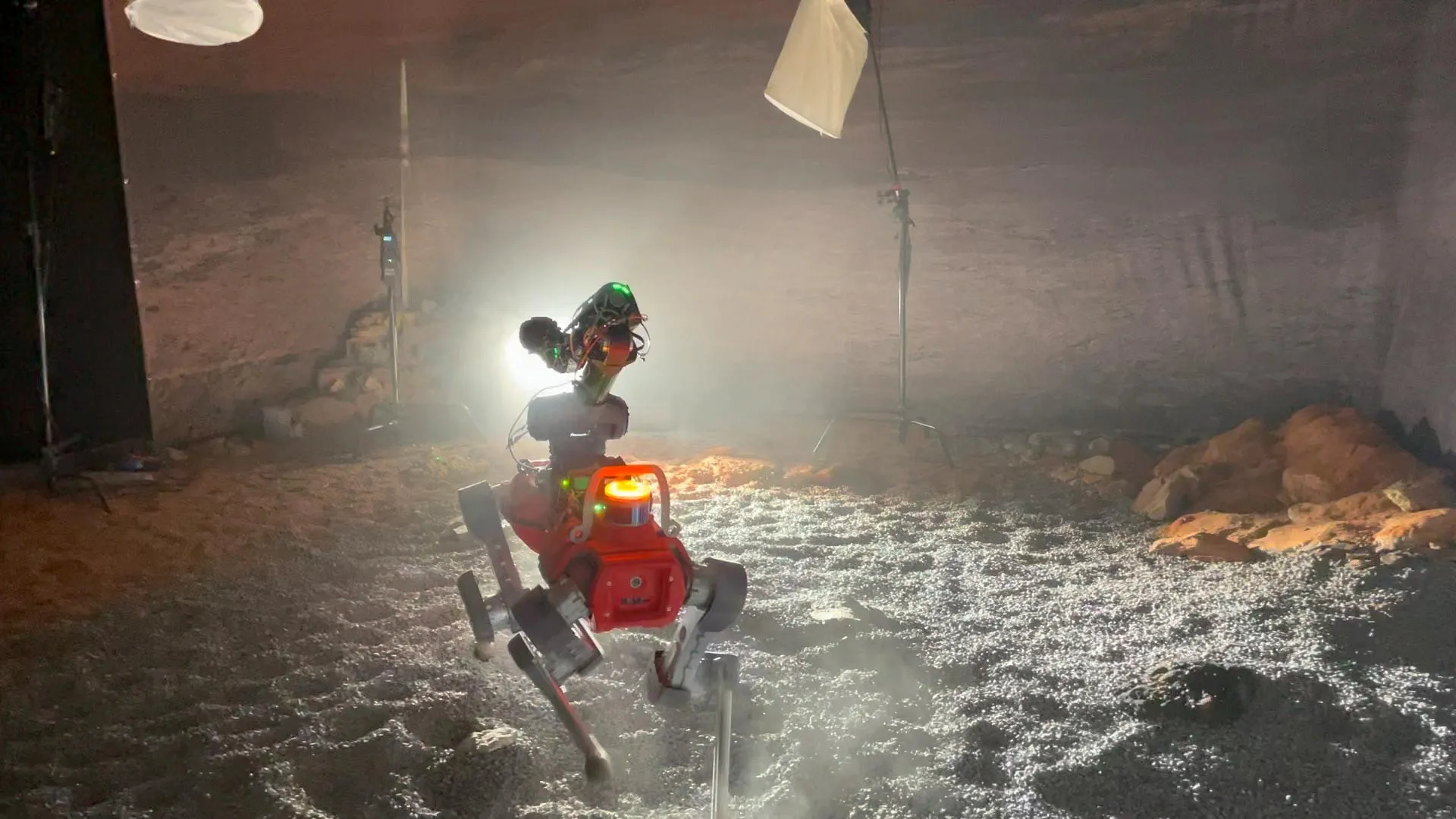
To demonstrate this concept, the researchers used the four-legged robot 'ANYmal.' It was equipped with a robotic arm holding two instruments: the microscopic imager MICRO and a portable Raman spectrometer developed for the ESA-ESRIC Space Resources Challenge. The project involved collaboration with the Robotic Systems Lab at ETH Zurich, ETH Zurich | Space, the University of Zurich, and the University of Bern.
Experiments took place at the 'Marslabor' facility at the University of Basel. This environment simulates planetary surface conditions using analogue rocks, 'regolith' (ie, planetary dust) materials, and analog lighting conditions. During the tests, the robot moved autonomously toward selected targets, positioned its instruments using the robotic arm, and transmitted images and spectral data for analysis.

